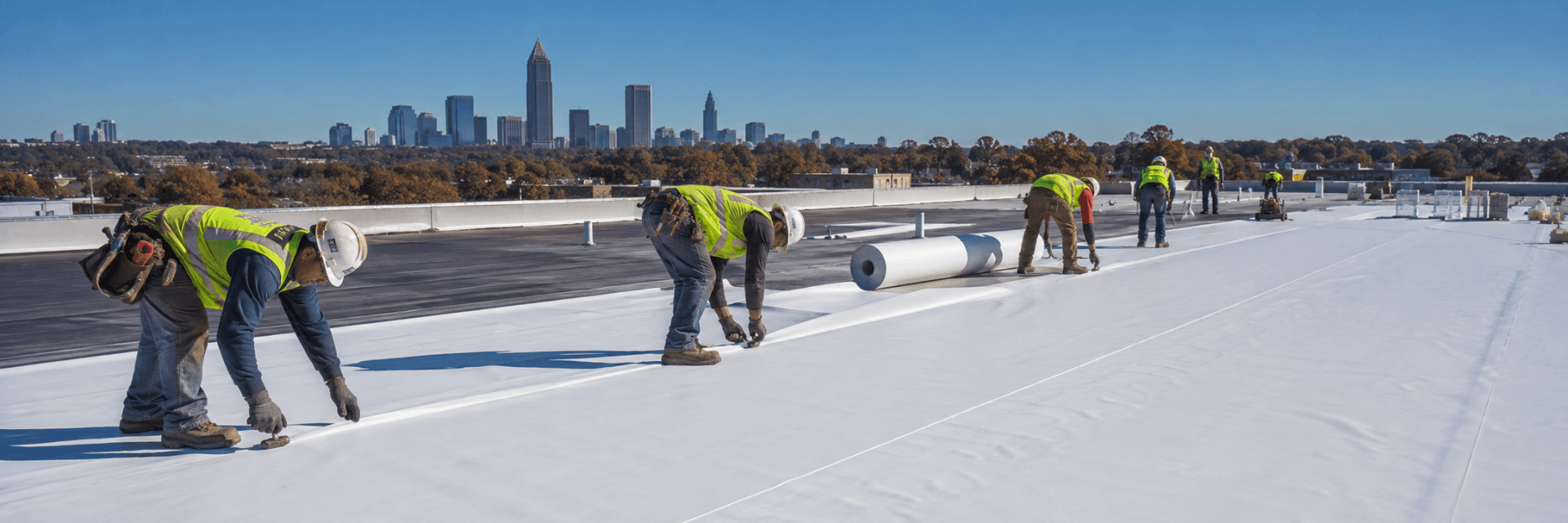
If you manage or own a commercial property in Metro Atlanta, the roof over that building is one of the most consequential decisions you will make. It affects energy costs, liability exposure, maintenance budgets, and the longevity of everything inside.
The problem is that most commercial property owners learn about roofing materials after a problem has already started. A failing roof, a major leak during a busy season, an insurance claim complicated by the wrong material for the building’s slope. All of it is common. Almost all of it is preventable.
This guide breaks down the most widely used commercial roofing materials, what each one is actually suited for, and how to think about the decision before a contractor presents you with a single option and calls it a day.
Why Commercial Roofing Is Different from Residential
Most commercial buildings have low-slope or flat roofs. That alone changes everything about how a roof must be designed and what materials are appropriate.
Residential roofing materials like asphalt shingles are engineered to shed water quickly on steep slopes. Put them on a low-slope commercial roof, and water pools and shingles fail prematurely. The same principle applies in reverse. Commercial membranes installed on a steep residential roof would look wrong and perform poorly.
Before evaluating any material, you need to know your roof’s slope, the building’s square footage, its age, how it is currently ventilated, and what kind of foot traffic or rooftop equipment it supports. A qualified roofing contractor will assess all of this before recommending anything.
The Most Common Commercial Roofing Materials
TPO (Thermoplastic Polyolefin)
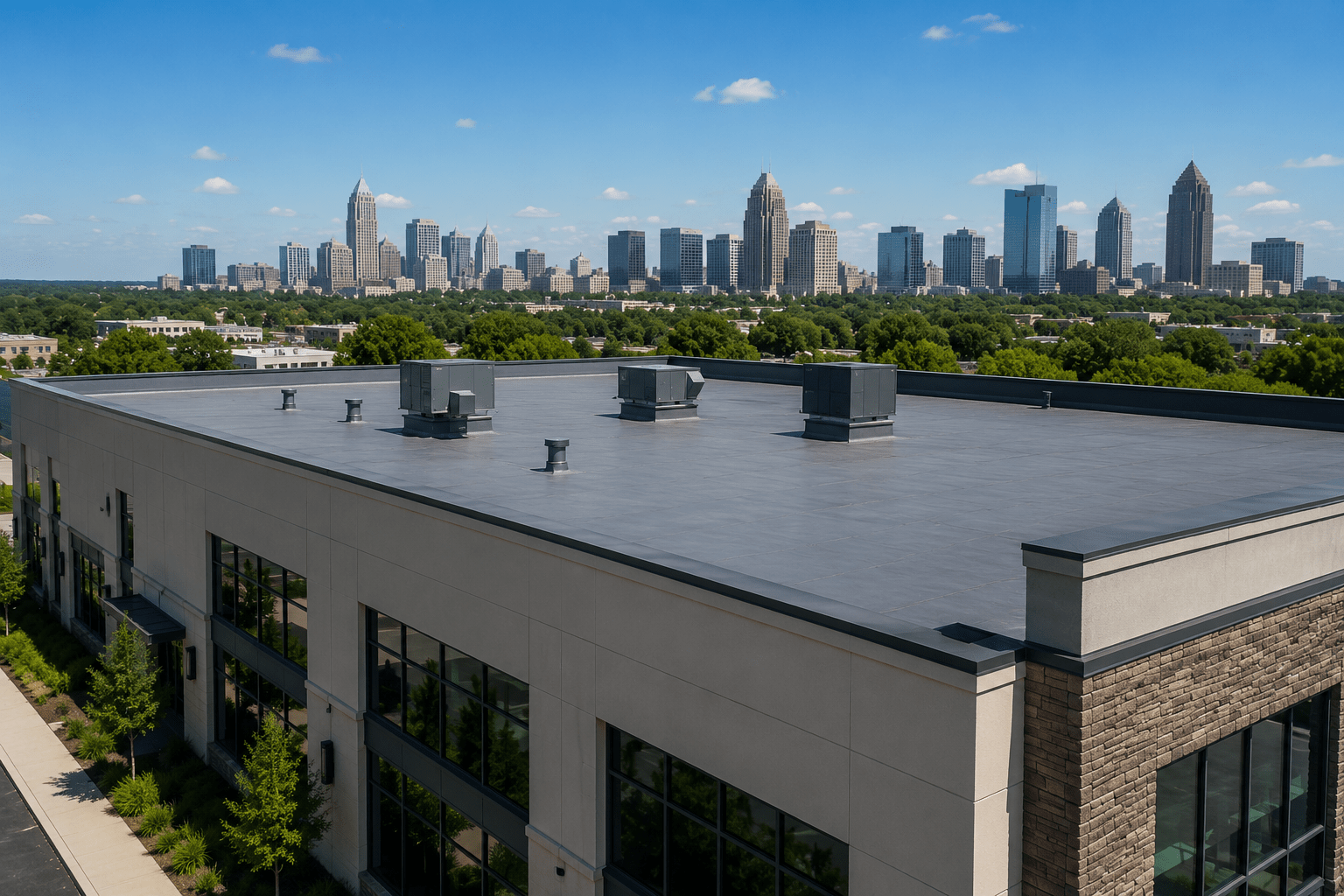
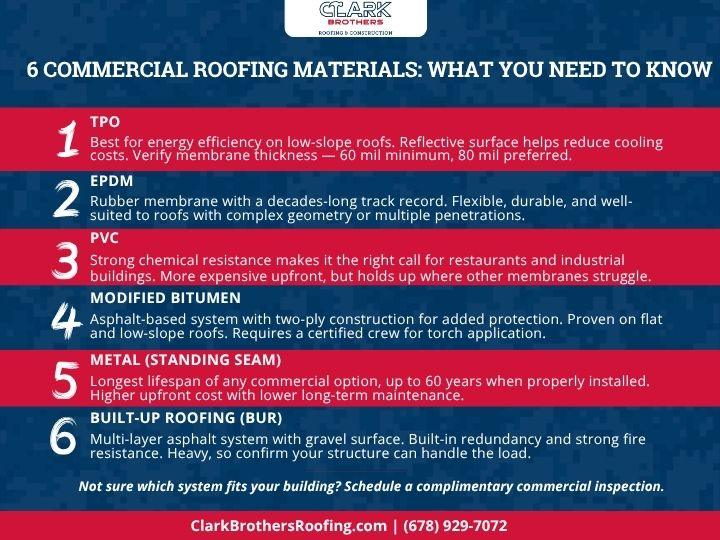
TPO is currently one of the most widely installed commercial roofing materials in the country, and for good reason. It performs well in Georgia’s climate, handles UV exposure, and reflects heat rather than absorbing it. That reflectivity can meaningfully reduce cooling costs during Atlanta’s long, hot summers.
TPO is a single-ply membrane, meaning it is a single sheet of material adhered, mechanically fastened, or ballasted across the roof deck. Seams are heat-welded, which creates a strong bond when installed correctly.
Best uses: Low-slope commercial roofs where energy efficiency is a priority. Retail spaces, warehouses, office buildings, and multi-tenant properties.
Considerations: TPO quality varies significantly by manufacturer. Thin membranes or poor installation can lead to early failure. Always verify the thickness (60 mil is standard; 80 mil offers greater durability) and confirm the installer is certified by the manufacturer.
EPDM (Ethylene Propylene Diene Monomer)
EPDM is a rubber roofing membrane that has been widely used since the 1960s. It is durable, flexible in cold temperatures, and carries a track record that newer materials simply cannot match. Some EPDM roofs installed correctly have lasted 30 years or more.
It is available in black and white. White EPDM reflects more heat, while black EPDM absorbs solar energy, which can actually be useful in colder climates. For Georgia properties, white or light-colored EPDM is generally preferred for energy performance.
Best uses: Low-slope roofs where proven longevity is the priority. Particularly well-suited to buildings with rooftop equipment, multiple penetrations, or complex geometry where a flexible membrane performs better than a rigid system.
Considerations: Black EPDM absorbs heat, which can increase cooling costs. Seam integrity is critical. EPDM seams are adhered with tape or contact cement rather than heat-welded, which requires careful installation. Puncture resistance is lower than TPO or PVC.
PVC (Polyvinyl Chloride)
PVC is another single-ply membrane with strong performance credentials. Like TPO, it is heat-welded at the seams. Where PVC differs is in its chemical resistance. It holds up better than TPO in environments where the roof is exposed to grease, oils, or industrial runoff. That makes it a strong choice for restaurant rooftops, food service facilities, and certain industrial applications.
PVC has a longer performance history than TPO and has demonstrated reliable long-term durability when properly installed. It typically costs more than TPO.
Best uses: Restaurant and food service properties, industrial facilities, or any building with rooftop equipment that produces grease or chemical exposure.
Considerations: PVC can become brittle over time, particularly in colder climates. It is also generally more expensive upfront than TPO or EPDM.
Modified Bitumen
Modified bitumen is an asphalt-based system that has been around since the 1970s. It is made from reinforced asphalt modified with rubber or plastic additives for improved flexibility and strength. It can be installed as a two-ply system, which adds an extra layer of protection compared to single-ply membranes.
It is installed using heat (torch-applied), cold adhesive, or self-adhering methods. Torch-applied systems require a certified installer due to fire risk during installation.
Best uses: Low-slope and flat roofs where impact resistance and a durable, proven system are priorities. Common in older commercial buildings and industrial properties.
Considerations: Torch application requires experienced crews. Dark-colored modified bitumen absorbs heat. Not as reflective as TPO or PVC without an additional coating. Requires regular maintenance and inspection to ensure seam integrity.
Metal Roofing
Metal roofing on commercial buildings includes standing seam panels, corrugated metal, and metal shingles. Standing seam systems are most common in commercial applications and work well on both low-slope and steep roofs, depending on the system.
Metal is one of the most durable roofing options available. Properly installed metal roofs can last 40 to 60 years. They are fire-resistant, hold up well in high wind, and require minimal maintenance compared to membrane systems.
Best uses: Any commercial property where long-term durability and low maintenance are the priorities. Industrial buildings, agricultural facilities, and commercial properties in storm-prone areas. Also common on mixed-use buildings where aesthetics matter.
Considerations: Higher upfront cost than most membrane options. Expansion and contraction with temperature changes must be accounted for in the installation. Can be noisy during heavy rain without proper insulation. Not suitable for very low slope applications without specific engineering.
Built-Up Roofing (BUR)
Built-up roofing, sometimes called tar and gravel, is one of the oldest commercial roofing systems still in use. It is constructed from alternating layers of bitumen and reinforcing fabric, then topped with a layer of aggregate (gravel or stone).
BUR systems are inherently multi-ply, which provides redundancy. If one layer develops a problem, the layers beneath it continue to protect the building. The gravel surface also provides UV protection and fire resistance.
Best uses: Flat commercial roofs where multi-layer protection and fire resistance are priorities. Common in older commercial buildings and still frequently specified for certain industrial applications.
Considerations: BUR systems are heavy. The building structure must be able to support the additional load. Installation is time-consuming and more labor-intensive than single-ply systems. Repairs can be harder to locate and complete cleanly.
How to Choose the Right Commercial Roofing Material
There is no universal answer, but there is a clear way to think through it. Work through these five factors before you talk to any contractor. They will help you walk into that conversation knowing what you actually need.
Start with your roof’s slope. Low-slope and flat roofs require membrane systems specifically designed to handle ponding water. That means TPO, EPDM, PVC, modified bitumen, or BUR. Steeper slopes open up additional options, including metal. If you are not sure of your roof’s slope, a contractor can measure it during an inspection.
Consider your energy costs. Georgia summers are long and hot. White and reflective membranes like TPO and white EPDM reflect heat rather than absorb it, which can meaningfully reduce cooling costs over time. If your energy bills are already a pain point, this factor deserves real weight in your decision.
Think about what happens inside your building. A standard office or retail space has different roofing requirements than a restaurant, a manufacturing facility, or a building with heavy rooftop equipment. Grease exposure, chemical runoff, and mechanical load all affect which materials will hold up and which will fail early.
Look at the full cost, not just the install price. TPO and modified bitumen typically cost less to install. Metal and PVC cost more upfront but tend to require less maintenance and last significantly longer. If you plan to own the property for 20 or more years, the cheaper install price may cost you more in the long run. Ask any contractor you interview to walk you through lifecycle cost, not just the day-one number.
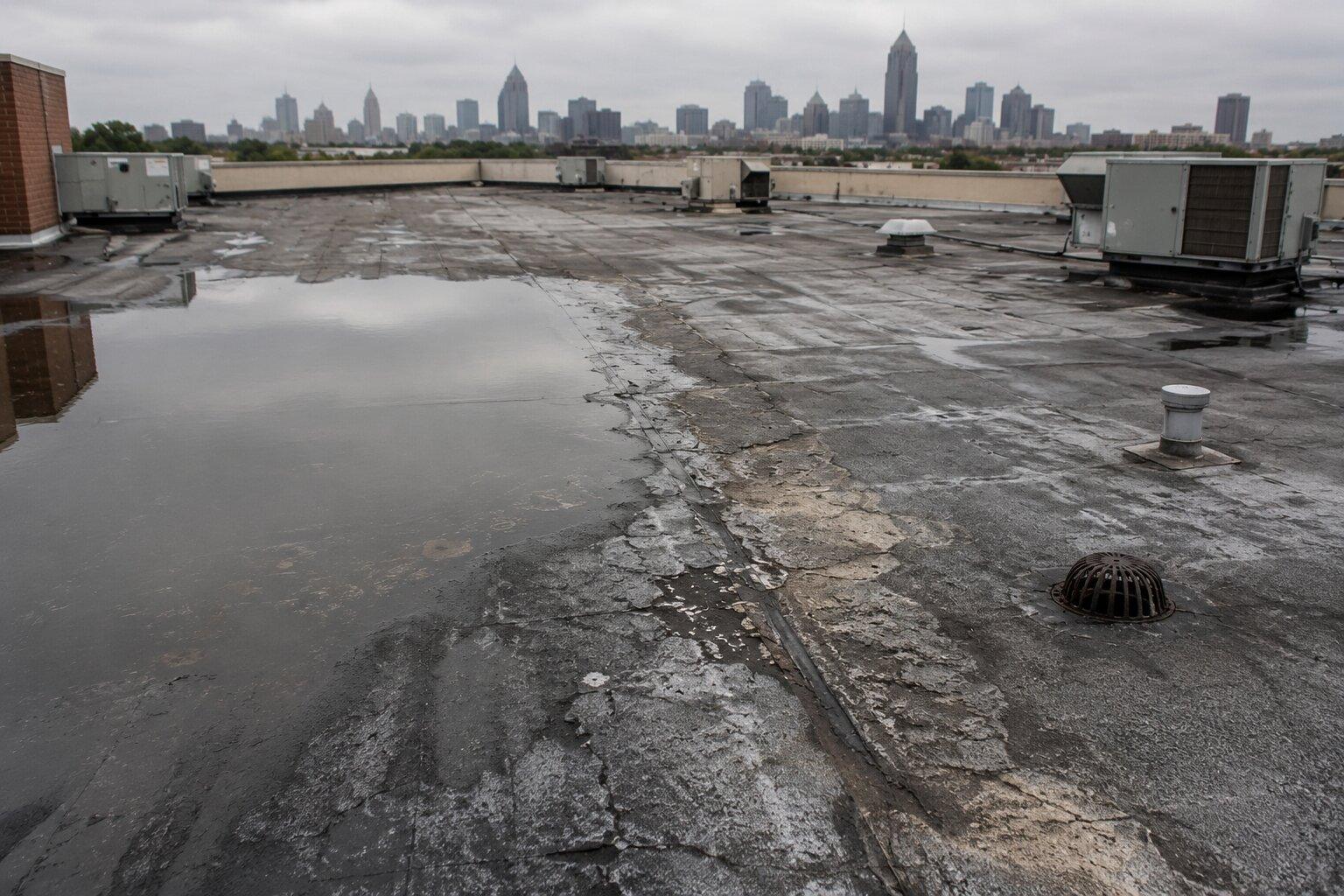
Know your current roof’s condition before you commit to anything. In some situations, a new membrane can be installed directly over the existing roof. In others, a full tear-off is required first. That difference can significantly change your budget and timeline. Only a thorough inspection will tell you which situation you are in.
The Role of Installation Quality
The material matters. The installer matters more.
A high-quality TPO membrane installed poorly will fail faster than a mid-range product installed by an experienced, manufacturer-certified crew. Seam integrity, proper flashing at penetrations and edges, adequate drainage slope, and correct fastener patterns all determine whether a commercial roof reaches its expected service life.
When evaluating contractors, ask for manufacturer certification for the specific material being proposed, a portfolio of similar commercial projects, and a written warranty that covers both materials and workmanship. A reputable contractor will provide all of this without hesitation.
What Clark Brothers Brings to Commercial Roofing Projects
Clark Brothers Roofing & Construction serves commercial property owners across Metro Atlanta with the same approach we bring to every project: no pressure, clear communication, and work done right the first time.
Our team handles commercial roofing installation, replacement, and repair across a range of systems. We provide thorough inspections, honest assessments, and detailed proposals that help property owners make informed decisions. Not rushed decisions.
If you manage a commercial property and want a straightforward evaluation of your current roof, we offer complimentary commercial inspections. We will tell you what we find, what it means, and what your options are.
Getting It Right From the Start
Commercial roofing is not a decision that rewards shortcuts. The material you choose, the contractor you hire, and the quality of the installation will determine how your roof performs over the next 20 to 40 years.
If you are ready to get a clear picture of where your roof stands, our commercial roofing team is here to help. No pressure, no rushing you toward a decision. Just honest information and a thorough inspection.