If you are ready to move forward with a commercial roofing project, pricing is probably one of the first things on your mind. You want a realistic sense of what you are getting into before you pick up the phone.
The honest answer is that commercial roofing costs vary too much to quote a number without knowing your building. Roof size, material choice, existing roof condition, slope, and the complexity of the installation all push the number up or down. A contractor who gives you a firm price without seeing the building is not giving you a real quote.
What we can do is walk you through the factors that drive cost so you can have a more informed conversation when you do sit down with a contractor. That conversation will go better when you understand what you are paying for and why.
Why Commercial Roofing Costs Vary So Much
Commercial properties are not uniform. A 5,000 square foot retail strip and a 50,000 square foot warehouse are both commercial buildings, but they have almost nothing in common from a roofing standpoint. The variables that matter most are the ones a contractor needs to assess in person.
That said, every commercial roofing project is shaped by a handful of consistent cost drivers. Understanding them will help you evaluate proposals and ask better questions.
The Factors That Drive Commercial Roofing Cost
Roof Size and Accessibility
Size is the most straightforward factor. Larger roofs cost more to replace or repair. But accessibility matters just as much. A roof that requires specialized equipment to reach, has limited staging area, or sits above an occupied building that cannot be shut down during installation will cost more than a roof of the same size on an easy-to-access structure.
Material Choice
The roofing system you choose has a direct and significant impact on cost. TPO and EPDM are typically on the lower end of the material cost range. PVC sits in the middle. Metal roofing, particularly standing seam systems, carries the highest upfront material cost but also the longest expected service life.
If you are not yet familiar with how these systems compare, the commercial roofing materials guide is a good place to start before committing to any one system.
Tear-Off vs. Re-Roofing
In some situations, a new membrane can be installed directly over an existing roof system. In others, the existing roof must be fully removed before new materials go down. Tear-off adds labor and disposal costs that re-roofing does not. Whether your building qualifies for re-roofing depends on the condition of the existing substrate, how many layers are already present, and local building code requirements.
This is one of the most significant cost variables in any commercial roofing project and one of the main reasons an inspection is the right first step before requesting proposals.
Roof Condition and Underlying Damage
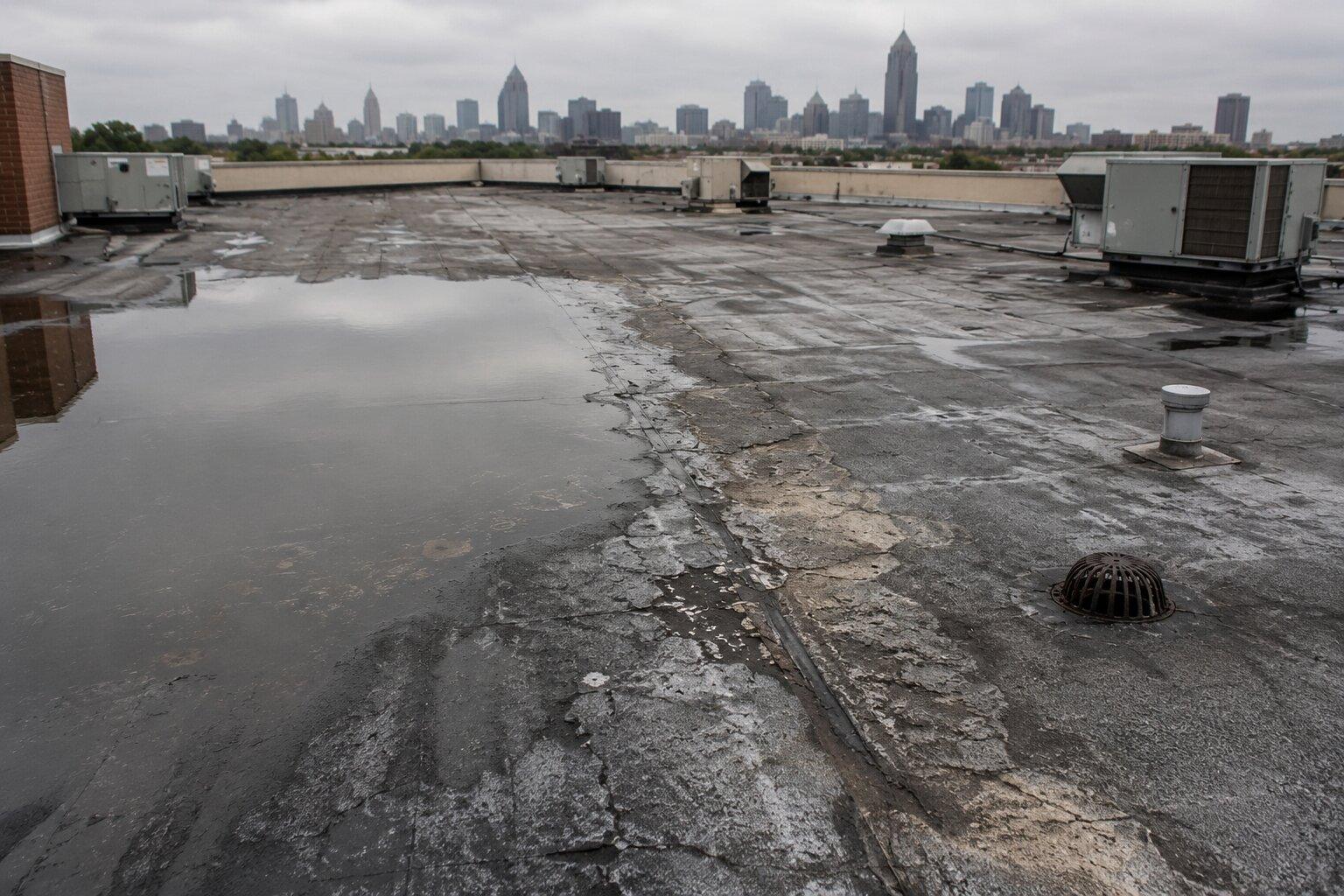
If your roof deck has sustained water damage, rot, or structural compromise, those issues need to be addressed before new roofing goes down. Repairs to the substrate add cost that is difficult to anticipate without a thorough inspection. A contractor who does not inspect the deck before quoting is leaving a significant unknown out of the proposal.
Penetrations, Flashings, and Complexity
HVAC units, skylights, vents, drains, and other rooftop equipment all create penetration points that require careful flashing and detailing. More penetrations mean more labor and more opportunities for installation errors. A roof with multiple complex details will cost more per square foot than a clean, open surface of the same material.
Project Timing and Scope
Emergency repairs and storm-related work often carry more premium pricing due to the urgency involved. Planned replacement projects, scheduled in advance during non-peak seasons, typically offer more competitive pricing. If your roof is approaching the end of its life but has not yet failed, acting before you are in emergency mode is almost always the better financial decision.

Repair vs. Replacement: How to Think About the Decision
Not every commercial roofing project is a full replacement. In some cases, targeted repairs extend the life of a roof significantly and at a fraction of replacement cost. In others, repeated repairs are a sign that the system has reached the end of its useful life, and further investment is just postponing the inevitable.
The decision between repair and replacement depends on the age of the roof, the extent and location of damage, how many repairs have already been made, and the overall condition of the membrane and substrate. A qualified contractor can help you understand where your roof sits on that spectrum.
Trying to make that call without an inspection is guesswork. The inspection is where the real information lives.
What to Watch Out for When Reviewing Proposals
Once you are ready to collect proposals, a few things are worth paying attention to beyond the bottom-line number.
Make sure each proposal specifies the material system, thickness, and manufacturer. A proposal that says “TPO roofing” without specifying a 60 mil or 80 mil membrane is not a complete proposal.
Confirm what the warranty covers and for how long. Material warranties and workmanship warranties are separate. Both matter. A contractor who cannot provide a written workmanship warranty is a contractor worth reconsidering.
Ask whether the contractor is manufacturer-certified for the system being proposed. Manufacturer certification is not just a credential. It is often required to activate the full manufacturer’s warranty.
Finally, make sure the proposal clearly states whether a tear-off is included or whether the quote assumes re-roofing over the existing system. That distinction can represent a significant cost difference, and it should never be ambiguous.
Getting to a Number That Actually Means Something
A ballpark figure from the internet will not help you plan a project. The only number worth having comes from someone getting on your roof, assessing what is there, and giving you an honest report.
Clark Brothers works with commercial property owners across Metro Atlanta on roofing installation, replacement, and repair. We start with a thorough inspection, give you a straight assessment of what we find, and provide a detailed proposal with no vague line items. If you want to see the full range of commercial roofing services we offer, that is a good place to start.
When you are ready to move forward, schedule your complimentary commercial inspection. We will tell you exactly what your roof needs and what it is going to take to get it done right.