
Most commercial roofing problems don’t announce themselves. They develop slowly. A seam that’s beginning to separate, flashing that’s pulled away from a parapet wall, a drain that’s gradually losing its seal. By the time water shows up inside the building, the damage has already been happening for a while.
A commercial roof inspection is how you find those issues before they become expensive. It’s also how you know the actual condition of your roof at any given point, which matters when you’re managing a maintenance budget, planning capital improvements, or navigating an insurance claim.
This guide covers what a professional commercial roof inspection includes, how often your building needs one, what to expect from the process, and how to make sure you’re getting useful information rather than a generic report.
Why Regular Commercial Roof Inspections Matter
A commercial roof is one of the most expensive building systems you manage. Replacement costs for a mid-size commercial roof in Metro Atlanta routinely run into six figures, depending on the system type and building size. The return on a regular inspection program is straightforward: small repairs identified early cost a fraction of what the same issues cost after they’ve been left to develop.
Beyond cost, there are a few practical reasons property managers in Atlanta should be inspecting their roofs on a defined schedule.
Georgia’s climate creates real stress on commercial roofing systems. High summer temperatures cause thermal expansion and contraction in membrane systems. Significant storm activity from spring through late summer creates wind, hail, and impact events that may not produce visible damage from the ground. Humidity accelerates deterioration in seams and flashing details that are already under stress.
Most commercial roofing warranties also have inspection requirements built in. Failing to conduct and document regular inspections can void warranty coverage on systems that are still relatively new. If your building has a roofing warranty, it’s worth confirming what the manufacturer requires to keep it active.
How Often Should a Commercial Roof Be Inspected?
The standard recommendation for most commercial roofing systems is twice per year, with inspections in spring and fall. The spring inspection catches anything that developed over the winter. The fall inspection prepares the roof for colder-weather conditions and identifies any damage from the summer storm season.
Beyond the twice-yearly schedule, inspections should also be conducted after any significant storm event. A storm that produces hail, high winds, or heavy sustained rain can create damage that isn’t visible from the ground and may not produce interior symptoms until the next rain.
Buildings with older roofing systems, known drainage issues, or rooftop equipment that requires frequent maintenance may benefit from more frequent inspections. If your roof is approaching the end of its expected service life, annual inspections are not enough to stay ahead of deterioration.

What a Commercial Roof Inspection Covers
A thorough commercial roof inspection is not a quick walk across the roof surface. It covers the full roofing system, including components that are often overlooked but frequently responsible for water intrusion.
Membrane Condition
For single-ply systems like TPO and EPDM, the membrane is the primary waterproofing layer. Inspectors assess the membrane for punctures, blisters, surface erosion, UV damage, and areas where the material has begun to shrink or pull away from edges and penetrations. On built-up and modified bitumen systems, the inspection looks at surfacing condition, blistering, and alligatoring.
Seam Integrity
Seams are the most common failure point on single-ply commercial roofing systems. Heat-welded seams on TPO should be probed to confirm they are fully adhered across their entire length. Taped or adhesive seams on EPDM systems require close inspection for separation, particularly after thermal cycling through summer heat. Any seam that has begun to open is a water entry point during the next rain event.
Flashing and Termination Details
Flashings at parapet walls, roof edges, penetrations, curbs, and transitions are inspected for separation, lifting, and sealant failure. These details are where most chronic leaks originate. A membrane that is in excellent condition across the field can still leak consistently if flashing details are not maintained.
Drainage Systems
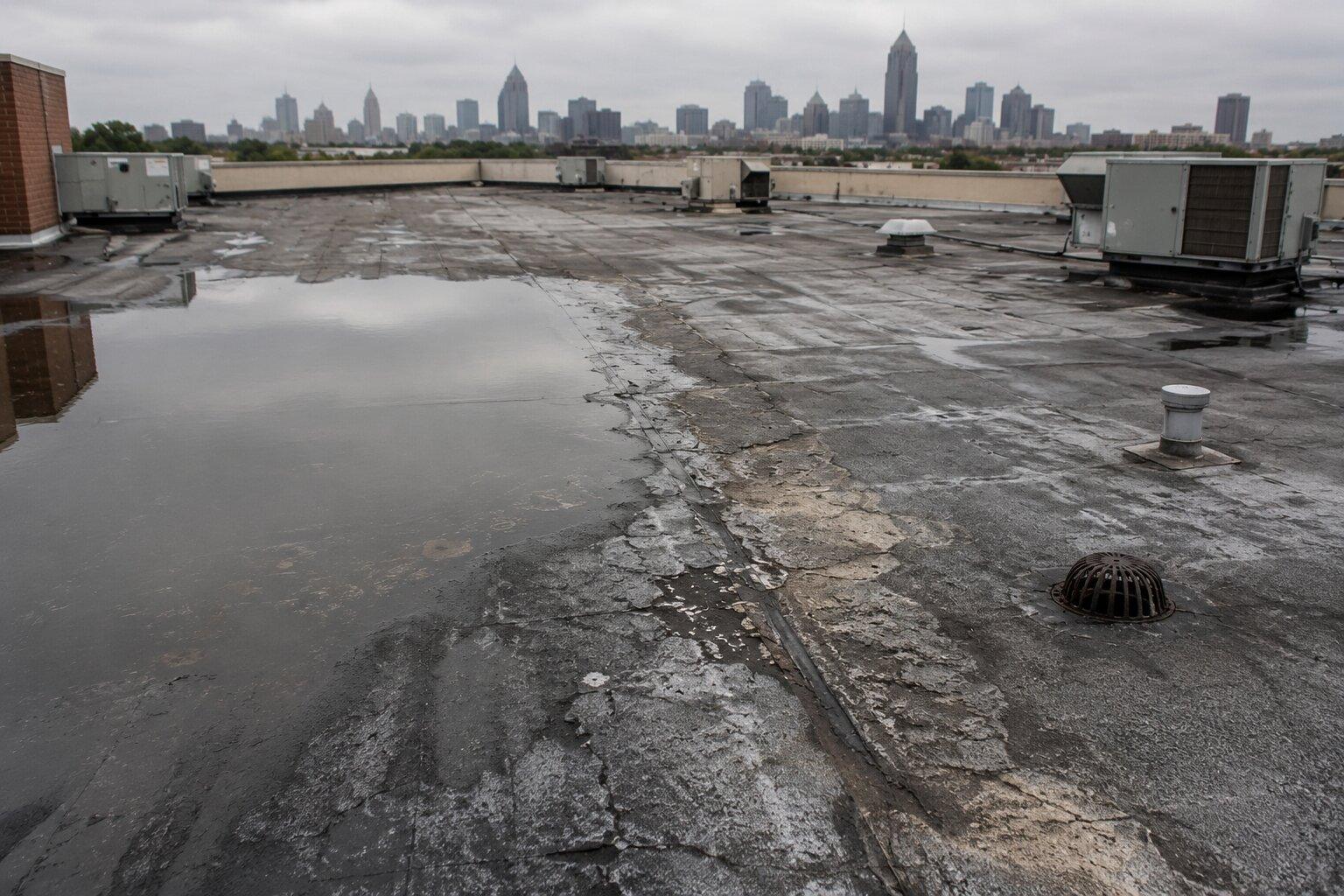
Roof drains, scuppers, and gutters are inspected for debris accumulation, proper attachment, and adequate flow capacity. Ponding water on a flat or low-slope commercial roof accelerates membrane deterioration and increases structural load. If drains are undersized or poorly positioned, that’s a design issue worth identifying regardless of the roof’s age.
Rooftop Equipment and Penetrations
HVAC units, exhaust fans, skylights, conduit, and any other rooftop equipment create penetrations through the membrane. The boots, curbs, and flashing details around each penetration are inspected for sealant condition, separation, and proper attachment. Equipment that has shifted or vibrated loose can damage the membrane surface and compromise surrounding waterproofing details.
Decking and Substrate Condition
Where membrane damage has allowed moisture to reach the substrate, inspectors look for soft spots, delamination, or deterioration in the decking material. Wet insulation and damaged decking significantly increase repair costs and may affect the roof’s structural capacity.

What to Expect During the Inspection Process
A professional commercial roof inspection should take between one and three hours for most buildings, depending on roof size, complexity, and the number of penetrations and rooftop equipment installations. Larger or more complex roofs take longer.
You should expect the inspector to access the roof directly rather than limiting the assessment to a ground-level or drone observation. While aerial photography and thermal imaging can be useful supplementary tools, they are not substitutes for a hands-on inspection that includes probing seams, testing flashing adhesion, and physically examining drainage components.
After the inspection, you should receive a written report that documents findings with photographs, identifies the location of each issue, and provides clear context for what needs immediate attention versus what should be monitored. A good inspection report gives you enough specific information to make informed decisions about repair priorities and budget planning.
Be cautious of inspection reports that are vague, lack photographs, or don’t provide specific locations for identified issues. A report that says “some seam separation noted” without specifying where and how extensive is not useful for planning or for insurance purposes.

Routine Inspections vs. Post-Event Inspections
Routine inspections and post-storm or post-event inspections serve different purposes and should be treated differently.
A routine inspection is about condition monitoring. The goal is to establish a baseline, track changes over time, and catch developing issues before they become failures. Routine inspection reports should be kept on file as part of your building’s maintenance documentation.
A post-event inspection is about identifying specific damage and documenting conditions before any repairs are made. If you’re working with an insurance carrier on a storm damage claim, the post-event inspection report is the foundation of your documentation. It should be detailed, date-stamped, and completed before any temporary or permanent repairs begin.
What to Look for in a Commercial Roofing Inspector
Not every roofing contractor has the experience or qualifications to conduct a useful commercial roof inspection. A few things worth confirming before scheduling:
- Direct experience with your specific roof system type. A contractor who primarily works with residential asphalt shingles may not have the training to properly assess a TPO, EPDM, or modified bitumen system.
- A clear inspection process with written documentation and photographs. Ask to see a sample report before scheduling. If the contractor can’t show you what the output looks like, that’s a meaningful signal.
- References from commercial clients, not just residential. Commercial and residential roofing are different trades. Experience with one does not automatically translate to the other.
- Knowledge of your warranty requirements. If your roof is under manufacturer warranty, the inspector should be familiar with what the warranty requires and what could affect coverage.
Clark Brothers provides commercial roof inspections throughout Metro Atlanta and North Georgia. Our team works with TPO, EPDM, modified bitumen, and built-up roofing systems on commercial and industrial properties. Learn more about our commercial roofing services.
Frequently Asked Questions
How much does a commercial roof inspection cost in Atlanta?
Cost varies based on roof size, complexity, and the scope of the inspection. Clark Brothers offers complimentary commercial roof inspections throughout Metro Atlanta and North Georgia. Schedule yours at clarkbrothersroofing.com/inspection.
Can I do a commercial roof inspection myself?
A basic visual check from the ground or through rooftop access points can help you spot obvious issues. But the damage that causes most commercial roof failures — seam separation, flashing lift, subtle membrane deterioration — requires close inspection by someone who knows what to look for and how to test it. Self-inspection does not substitute for a professional assessment and will not satisfy warranty requirements.
How long does a commercial roof last?
Service life depends on the system type, installation quality, maintenance history, and local climate conditions. In Metro Atlanta, well-maintained TPO and EPDM systems typically last 20 to 30 years. Modified bitumen and built-up systems have similar ranges. Roofs that are not inspected and maintained regularly tend to fail significantly earlier than their designed service life.
What is the difference between a roof inspection and a roof assessment?
These terms are sometimes used interchangeably, but a formal roof assessment typically involves a more comprehensive evaluation that includes remaining service life projections, capital planning recommendations, and sometimes thermal imaging to locate moisture in the insulation layer. A standard inspection focuses on the current condition and immediate repair needs. If you’re planning a capital budget or evaluating a building for purchase, a full assessment is worth the additional investment.
Does Clark Brothers inspect commercial roofs throughout Metro Atlanta?
Yes. Clark Brothers provides commercial roof inspections across Metro Atlanta and North Georgia. Reach us at (678) 929-7072 to schedule an assessment for your property.
A commercial roof that’s inspected regularly costs less to maintain over its life than one that isn’t. The issues that produce the largest repair bills are almost always ones that were visible well before they became failures. Inspection is how you find them first.
If it’s been more than a year since your building’s last professional roof inspection, or if you’ve recently been through a significant storm event, the Clark Brothers commercial team is available to help. Contact us at (678) 929-7072 or visit our website to learn more about our commercial roofing services.
For more commercial roofing guidance built specifically for property managers and building owners in Metro Atlanta, explore our commercial roofing resource center.